
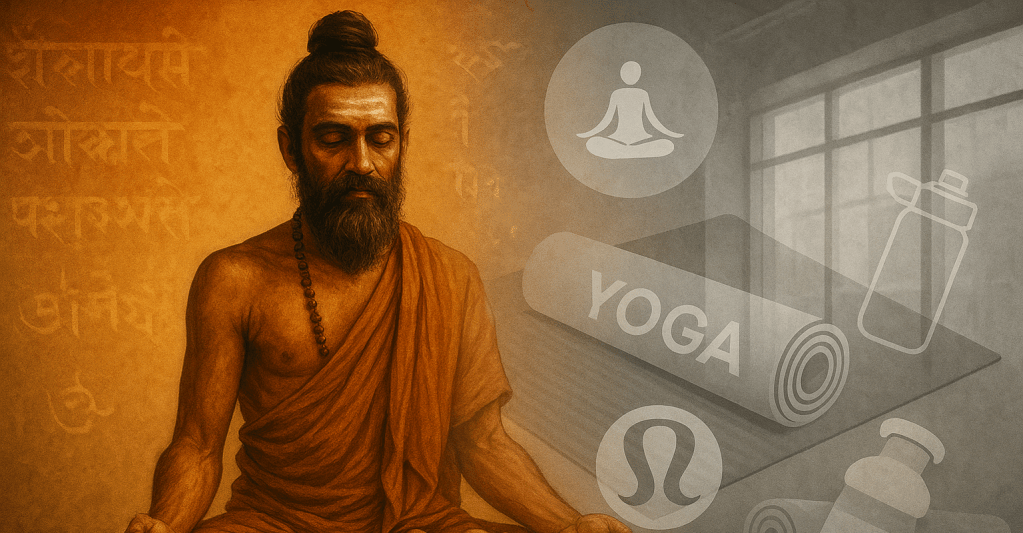
From Sacred Practice to Global Commodity
In the modern age, yoga has undergone significant transformation. On one hand, it has evolved—adapting to the lives of contemporary people. On the other, it has been uprooted from its cultural and spiritual origins. Yoga today is often reduced to a wellness trend, divorced from the philosophical and ethical framework it emerged from.
Historically, yoga was transmitted from master to disciple, within distinct philosophical traditions like Sāṅkhya and Tantra. The Sāṅkhya-rooted systems of Hatha and Raja Yoga emphasized structure, discipline, and precision. These systems insisted on strict practice, not out of dogma, but to prevent harm: improper execution of asanas or breathwork could lead to physical or mental imbalance.
Tantra, however, introduced a more exploratory and inclusive approach. It opened yogic practices to those outside the Brahmin class, often through esoteric means—rituals, deity visualizations, and direct transmissions through visionary experience. Even Siddhartha Gautama (the Buddha), after mastering various yogic and tantric disciplines, acknowledged their value in stages of development, but ultimately transcended them in pursuit of enlightenment.
This openness birthed lineages where yoga was received through scripture, oral transmission, and mystical experience. But with accessibility came dilution.
Modernity, Mental Health, and Marketing
Yoga’s mainstream acceptance has brought health benefits to many, especially the elderly and those struggling with chronic illness or stress. As technology grows more addictive and life more fast-paced, yoga appears as a balm for physical and mental well-being.
However, this popularity has also led to commodification. Brands exploit the visual and emotional appeal of yoga to sell products and lifestyles. This results in what some call “Instagram Yoga”—where personality eclipses philosophy. When personal identity overrides tradition, distortion follows. The hypothetical idea of “Gun Yoga” may seem absurd—until it becomes mainstream through repetition and consumer demand. In this surreal future, practitioners may only see yoga as gun-yoga, thereby legitimizing it.
In fact, this is already happening with many yoga ‘styles’ commodified in today’s marketplace.
Colonial Shadows and Western Appropriation
Many practitioners, often unknowingly, engage with yoga in ways that disregard its origins. This is not only a failure of individual teachers but a broader result of colonial history, where cultural practices were first demonized, then appropriated and monetized.
Over the last two millennia, yoga has evolved through philosophical and social shifts in India. As early as the 1st century BCE, ascetics like Zarmanochegas reportedly traveled to the West. His act of self-immolation in Athens, misunderstood as spectacle, illustrates how Indian yogic practices were historically misrepresented by outsiders—from Strabo to Marco Polo to François Bernier.
British colonizers in the 1600s, like John Fryer and John Ovington, viewed yogis as satanic or bizarre. Ironically, these same practices would later be repackaged to suit Western tastes.
In the late 19th and early 20th centuries, Indian teachers sought to correct misconceptions. Swami Vivekananda emphasized Raja Yoga and downplayed Hatha Yoga to appeal to the West. Paramahansa Yogananda introduced Kriya Yoga in the 1920s, blending Indian spirituality with Western ideals of success and self-improvement. Though he inspired millions, this also marked yoga’s shift into marketable spirituality, aided by patrons like James J. Lynn (Rajarsi Janakananda).
But some distortions were dangerous. Jakob Wilhelm Hauer, a German Indologist, misused yogic texts to support Nazi racial ideologies. Later, the BBC’s yoga broadcasts (1948) and Richard Hittleman’s Yoga for Health series further reduced yoga to physical exercise, stripping away spiritual substance.
The Indian Revival and the Western Takeover
By mid-20th century, Indian masters like Krishnamacharya, B.K.S. Iyengar, Pattabhi Jois, and Indra Devi began systematizing asana-based yoga to appeal to a global audience. While their intent was not always to commercialize yoga, their work laid the foundation for the Western wellness boom.
Indra Devi taught yoga to Hollywood stars and emphasized its therapeutic benefits, omitting its philosophical depth. Iyengar’s Light on Yoga became a global manual, but focused on posture, not inner transformation.
From the 1970s onward, yoga studios in the West proliferated, aligning more with fitness trends than with sādhanā. The Yoga Journal, founded in 1975, played a key role in this shift. Its white-centered imagery and consumerist framing helped build a billion-dollar industry—but also raised accusations of cultural appropriation.
The British Wheel of Yoga became the UK’s official regulatory body, formalizing yoga education with a secular, physical emphasis. Meanwhile, mindfulness movements like Jon Kabat-Zinn’s MBSR further secularized Eastern traditions, adapting Buddhist meditation to clinical settings while erasing its spiritual roots.
The Problem with Modern Yoga Gurus
The rise of modern yoga gurus and influencers reflects a growing disconnect between yoga’s presentation and its purpose. They offer yoga as a consumable lifestyle or performance art, rather than a path of self-realization.
In the Bhagavad Gita, Krishna warns of false teachers who distort dharma for personal gain. Today’s market-driven teachers may unwittingly contribute to this problem by emphasizing what sells over what heals.
It’s important to acknowledge: modern humanity is suffering. Craving, aversion, trauma, and disconnection are widespread. The full system of yoga—yamas, niyamas, asana, pranayama, pratyahara, dharana, dhyana, and samadhi—was designed to address these core issues, not just tone the body or calm the mind temporarily.
Restoring Integrity: What Can Be Done?
To preserve yoga’s integrity, we must:
- Educate teachers in its full system, not just postural practice.
- Recognize trauma—cultural, historical, and personal—and how it influences modern practice.
- Respect lineage—study with authentic teachers and honor the tradition you teach.
- Avoid commodifying sacred symbols, deities, and philosophies.
- Create access for all—yoga is not a white achievement or property.
Yes, yoga can be adapted. Yes, it should evolve. But that adaptation must come from informed transformation, not erasure. The aim of yoga has always been liberation—not profit, performance, or popularity.
If you are a model, actor, gymnast, romantic, comedian, or business person teaching yoga, you are welcome—as long as you relinquish ego, stay grounded in study, and avoid misrepresenting what yoga truly is. Teach what you know, and learn what you don’t. Don’t distort an ancient practice to fit a fleeting trend. Instead, root your teaching in the aim of yoga: to free yourself from suffering.


 Amman Advaita
Leave a reply to Latika gupta Cancel reply