
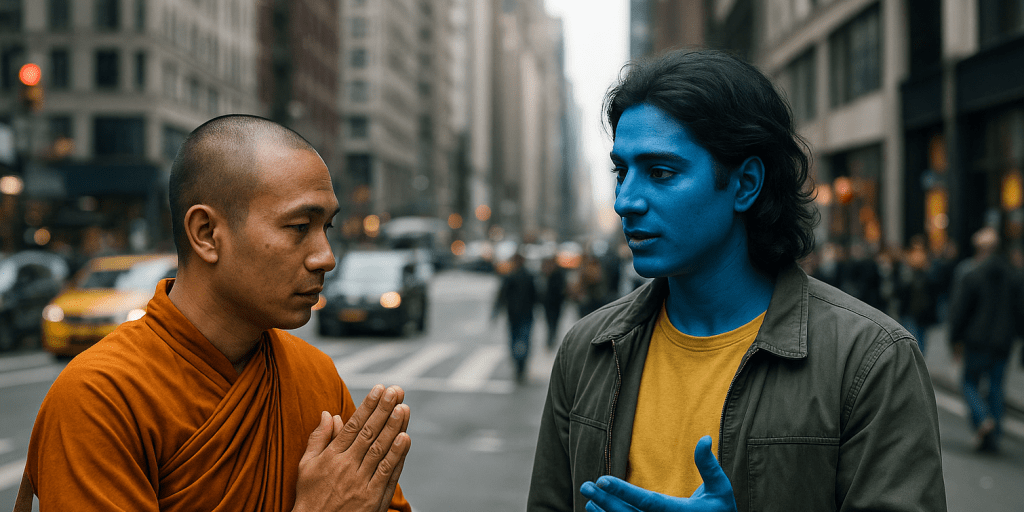
In the Mahabharata, when the war of Dharma unfolds on the battlefield of Kurukshetra, Arjuna stands at the brink of battle, facing not only an opposing army but his own inner world projected outward. The Kauravas—his cousins—each represent qualities Arjuna has grappled with within himself.
Arjuna, on the other hand, represents the Ekagra chitta—the one-pointed, focused mind. In yogic psychology, this is the state of mind prepared for deep communion with the divine. Arjuna is the yogi at the crossroads, the aspirant whose tapas has readied him to hear the teachings of Kṛṣṇa—not as a friend alone, but as the charioteer of consciousness.
Each of us falls within one of these states of mind, as defined by Patanjali’s Yoga Sutras:
Kshipta (scattered mind) – Their attachment sometimes paralyzes them from taking decisive action.
Mudha (dull or tamasic mind) – Ruled by rage and appetite, they embody brute force and emotional impulsivity.
Vikshipta (distracted or oscillating mind) – They waver between virtue and ego, duty and pride.
Ekagra (focused mind) – They are the one-pointed seeker who is now ready to receive divine instruction.
Niruddha (fully restrained mind) – They are the silent seer, introspective and wise, embodying the potential of inner mastery.
So when Kṛṣṇa tells Arjuna:
“Karmanye vadhikaraste, Ma phaleshu kadachana,
Ma karma phala hetur bhur, Ma te sangostva akarmani”
“You have the right to act, but not to the fruits of your action. Never consider yourself the cause of the results, and never be attached to inaction.”
—he is inviting Arjuna, and through him all of us, to act not from craving or fear, but from presence, alignment, and surrender. It is not a denial of results, but a call to detach from obsessing over them.
But how many of us truly perform an action without desiring its fruit?
Even in the smallest things—taking a sip of water to quench thirst—there is an underlying motivation. And this motivation is not wrong. In fact, it’s essential to being human. The key lies not in abandoning desire altogether, but in becoming conscious of our motivations. Are they arising from fear? Ego? Insecurity? Or are they arising from a deeper impulse—love, truth, surrender?
In today’s world, to “not want the fruit” can sound like lacking ambition. If someone asks why you want a promotion, and you say, “I don’t know,” you might be judged as unfocused or unmotivated. Yet, how many of us truly know where we are going?
We construct visions of the future, assume control over outcomes, and even advise others on what their futures should look like. In doing so, we often mistake the dream for the doer, the map for the territory.
And when the fruit finally arrives—be it success, recognition, pleasure—we experience a surge of neurotransmitters:
dopamine (anticipation and reward),
serotonin (social status, satisfaction),
endorphins (euphoria, especially after effort), and
oxytocin (connection and love).
Science confirms that these chemicals play a huge role in our “happiness highs.” But every high has its crash. Like the fleeting climax of orgasm, the joy dissolves quickly, leaving us chasing the next fix. We’ve been conditioned since birth to chase what doesn’t last. This is the wheel of samsara, the endless cycle of becoming.
And so we spend lifetimes trying to create a future that will satisfy the aching desire born of the past. Even in death, many of us long to return—not for liberation, but to taste the fruits we missed. We create heavens that resemble earthly pleasures, not yet ready to be free.
But what Kṛṣṇa offers Arjuna is not mere victory. He offers freedom. A freedom that comes from acting without attachment to the fruit, and resting instead in the deeper fruit—the communion with the divine presence within. This communion is the fruit that does not rot, the joy that does not crash, the union that does not end.
Once that inner taste awakens, the world remains the same—but we are not the same.
Then, the thirst that drives compulsive action is replaced by a quiet joy. Actions arise naturally, effortlessly, as expressions of the divine will. We don’t do for fruit—we become the fruit. Sweet, ripe, offering ourselves back to the tree of life without resistance.
And so, may we live as Arjuna was taught to live—not passively, but purposefully; not for gain, but for truth. May our practice ripen within us the kind of fruit that nourishes both self and world.
Such a sweet one, such a pleasant one, such a one ripe for the divine.
May we be that.
Sarva Mangalam.
 Amman Advaita
Leave a comment