
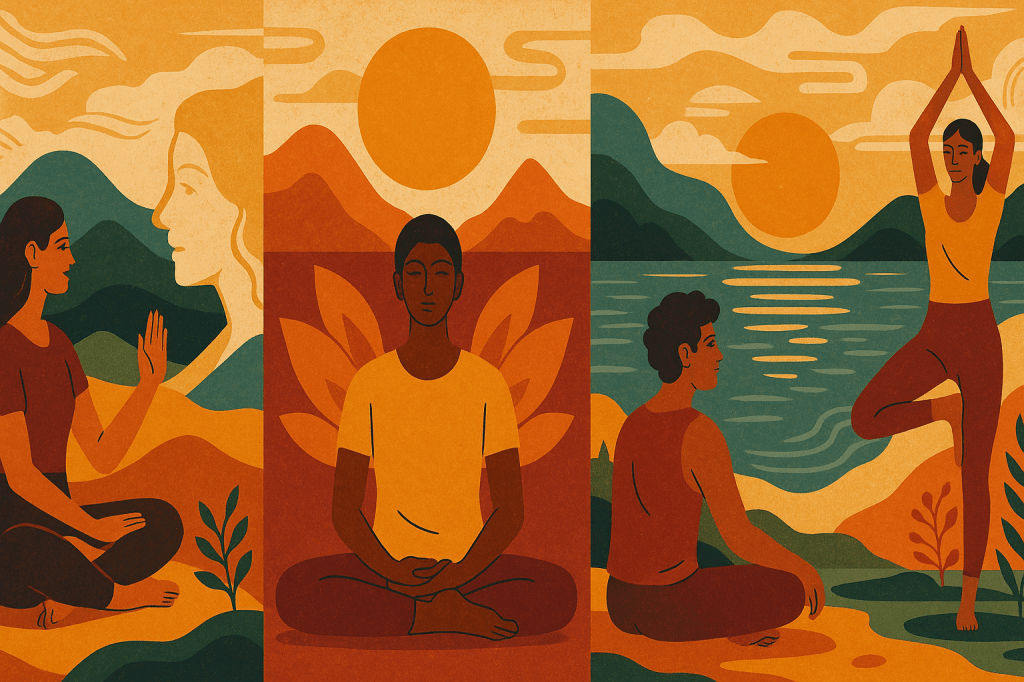
Let us first understand what we mean by yogic ethics. Yoga, at its core, is not merely physical postures or breath control—it is synonymous with samadhi, the pure, clear, concentrated essence of being. A state where the fluctuations of the mind have ceased, and one abides in that which is unchanging.
For many of us living in what scriptures call the Kaliyuga—the age of confusion, degeneration, and distraction—this state seems not just distant but inconceivable. And that’s precisely why it feels unattainable: by nature, it transcends the very faculties we typically use to “understand.” So, one may rightly question the point of striving toward something so elusive, through what is often dismissed as an abstract or outdated path.
Yet, no matter how much we question, it is vital to understand both the theory and the application of the path. They go hand in hand. Without theory, we cannot make sense of the experiences that arise from our practice. Without practice, theory remains dry, conceptual, and disconnected from lived reality. My intention here is to bridge the two through my own experience, because the value of the path lies in their integration.
At first glance, yoga may appear selfish—focused on liberating oneself from the suffering of the perceived world, including one’s own patterns, traumas, and deep inner wounds. But in reality, even the intention to free oneself from suffering is a radically compassionate act. It requires courage, and often it is the toughest and most important step.
Most modern practitioners don’t align with the original intention of the path. The idea of withdrawing the mind from the senses, transcending the dualities of pleasure and pain, or dissolving the egoic self seems either impossible or undesirable. Why, they wonder, should anyone want to cease to be?
As a result, many stop at the temporary benefits that yoga practices offer: relief from stress and anxiety, improved physical health, and moments of calm. These are valuable, of course, but from the yogic perspective, they are only survival tools—like holding on to a trembling asana, afraid to move deeper.
Understanding this, the ancient masters provided a framework—not just for practice, but for how to live. Before one even begins to meditate or perform asanas, the foundation must be built. This foundation is called Yama and Niyama—the restraints and observances. These are not commandments or rigid moral codes. They are psychological trainings designed to calm the inner world, preparing one for the subtler aspects of yoga.
In fact, to embody the yamas and niyamas is to live in a state of yoga itself—to dwell in samadhi while in the world. Today, we’re not trying to master them. Instead, let us reflect on how these principles are already present—latent—in our daily life, and how recognizing them can bring transformation.
1. Ahimsa – Non-Violence
The instinct to protect ourselves, often through aggression or withdrawal, is rooted in deeply embedded patterns of past violence—biological, cultural, and karmic. Our brainstem still reacts as if every discomfort is a life-threatening situation. The practice of ahimsa is to interrupt this automatic loop.
Violence—whether through words, tone, action, or even inner thought—perpetuates itself. But so does non-violence. So begin by noticing when you do not react violently. When, in the face of challenge, you choose a softer response. Reward that moment internally. Gratitude, here, is a rewiring tool—it transforms neural pathways. Each act of restraint, of kindness, is a seed planted in the soil of peace.
2. Satya – Truthfulness
Truth is not a static object but a dynamic process. Most of what we believe to be “truth” is layered with inherited beliefs, unexamined emotions, and cognitive bias. Often, we speak not from truth but from fear, pride, or the need for validation—driven by the kleshas (afflictions) of ignorance, attachment, and aversion.
We needn’t become moral absolutists, but we can cultivate pauses. A moment of silence before reacting, boasting, flattering, complaining, or gossiping allows a truer response to emerge. And when we do lie—consciously or not—it’s often because we are lying to ourselves. Truthfulness begins in introspection, not in speech.
When we sit with ourselves in silence, we dissolve the false subject—allowing truth to surface not as a concept, but as presence.
3. Asteya – Non-Stealing
Most of us don’t steal in the conventional sense. But asteya goes beyond possessions. It asks: are we stealing attention, time, credit, energy, peace—from ourselves or others?
At the heart of stealing is a deep sense of lack—a disconnection from our own worth. Like the preta (hungry ghost) in Buddhist cosmology, we may grasp endlessly for more, yet never feel satisfied. We may dress ourselves in borrowed identities, hoard validation, or envy what others have—yet none of this resolves the inner void.
The true practice of asteya is to honour our inherent worth. To cultivate enoughness. When we respect ourselves, we stop grasping at what belongs to others. We begin to see the futility of theft—whether it’s material or emotional. Nothing acquired this way brings peace. But when we give ourselves fully to our own path, we gain what no one can take away.
4. Brahmacharya – Right Use of Energy (Often Interpreted as Sexual Control)
Brahmacharya is not only celibacy. It’s mastery of desire—not repression, but redirection. It recognizes the creative power of sexual energy, and guides it toward conscious evolution rather than compulsive indulgence.
The brain is a sexual organ. Desire begins not in the genitals but in the mind. So self-mastery begins by observing how thoughts ignite sensations. Over time, we learn that arousal is not a command—it’s a signal, and one we can choose how to engage with.
We can begin by noticing—when is this energy arising? Can we hold it? Can we redirect it into creativity, insight, devotion, discipline? Even small acts of restraint build inner power. This force is not something to be feared, but to be honoured. Properly channelled, it is the same force that leads to art, love, service, even samadhi.
5. Aparigraha – Non-Attachment / Non-Possessiveness
What do we truly own? The body? It changes every second. Identity? It shifts with each thought, each memory. Our beliefs, roles, relationships—all are impermanent.
Attachment arises when we grasp for permanence in a world that is in flux. The pain of loss is not the loss itself, but the shock of our assumption that things wouldn’t change.
Aparigraha is not about renunciation for its own sake. It’s about making peace with change. We begin by noticing where we cling—objects, titles, routines, even our self-image. And then, we soften that grip.
Small daily experiments help: sit in a different spot, take a different route, let someone else win an argument. Practice fluidity. Let your sense of self become porous. In doing so, we begin to taste freedom.
Conclusion: From Personal to Collective Transformation
These five ethics—Ahimsa, Satya, Asteya, Brahmacharya, and Aparigraha—are not moral prescriptions. They are trainings in awareness and integrity. Practicing them benefits the individual, yes—but their ripple effects are societal.
In a world that is increasingly fractured, reactive, and driven by surface values, the one who even attempts to live by yogic ethics is a stabilizing force. They need not preach. Simply by embodying these values, their presence uplifts. They become a refuge, a mirror, a reminder of what is possible.
The ethics of yoga teach us that loving others is not separate from loving ourselves. The community flourishes when its individuals are whole. Yoga transforms not just bodies, but entire systems—by working through the smallest of actions, repeated with clarity and devotion.
Start small. Observe. Honour the tiny shifts. Live the ethics, not tomorrow, but today.
 Amman Advaita
Leave a comment